Customers rarely measure payment speed in seconds. They measure it emotionally.
A transaction that feels instant feels reliable. A transaction that feels delayed creates uncertainty. That uncertainty matters more than many businesses realize.
In digital commerce, payment speed is no longer just an operational metric. It has become a behavioral trust signal. The faster and smoother a payment experience feels, the more confident customers become in the business behind it.
And in a market like the UAE, where digital expectations are accelerating rapidly, slow or inconsistent payment experiences can quietly damage trust long before a customer complaint ever appears.
Customers associate speed with reliability
Behavioral science has long shown that humans interpret speed as competence. People trust systems that reduce friction. They become anxious when processes feel delayed, unclear, or unpredictable. This is especially true in payments because money creates emotional sensitivity.
The moment a customer clicks “Pay,” they expect certainty:
- Did the payment go through?
- Was money deducted?
- Will the order fail?
- Should they retry?
- Did they get charged twice?
Even a short delay can trigger cognitive discomfort. Behavioral research around digital payments shows that consumers associate speed, simplicity, and reliability with higher trust in digital transactions. (IJSET Research)
This is not just a technology issue. It is a perception issue.
Why the brain reacts so strongly to payment speed
Humans are wired to interpret speed as a signal of certainty. Behavioral science shows that the brain constantly uses shortcuts to judge whether something feels safe, reliable, or trustworthy. In digital experiences, speed becomes one of those shortcuts.
When a payment happens instantly, customers subconsciously interpret it as:
- The system is working
- The business is credible
- The transaction is secure
- The outcome is predictable
But when there is delay, silence, or uncertainty, the brain starts searching for risk. That reaction happens quickly.
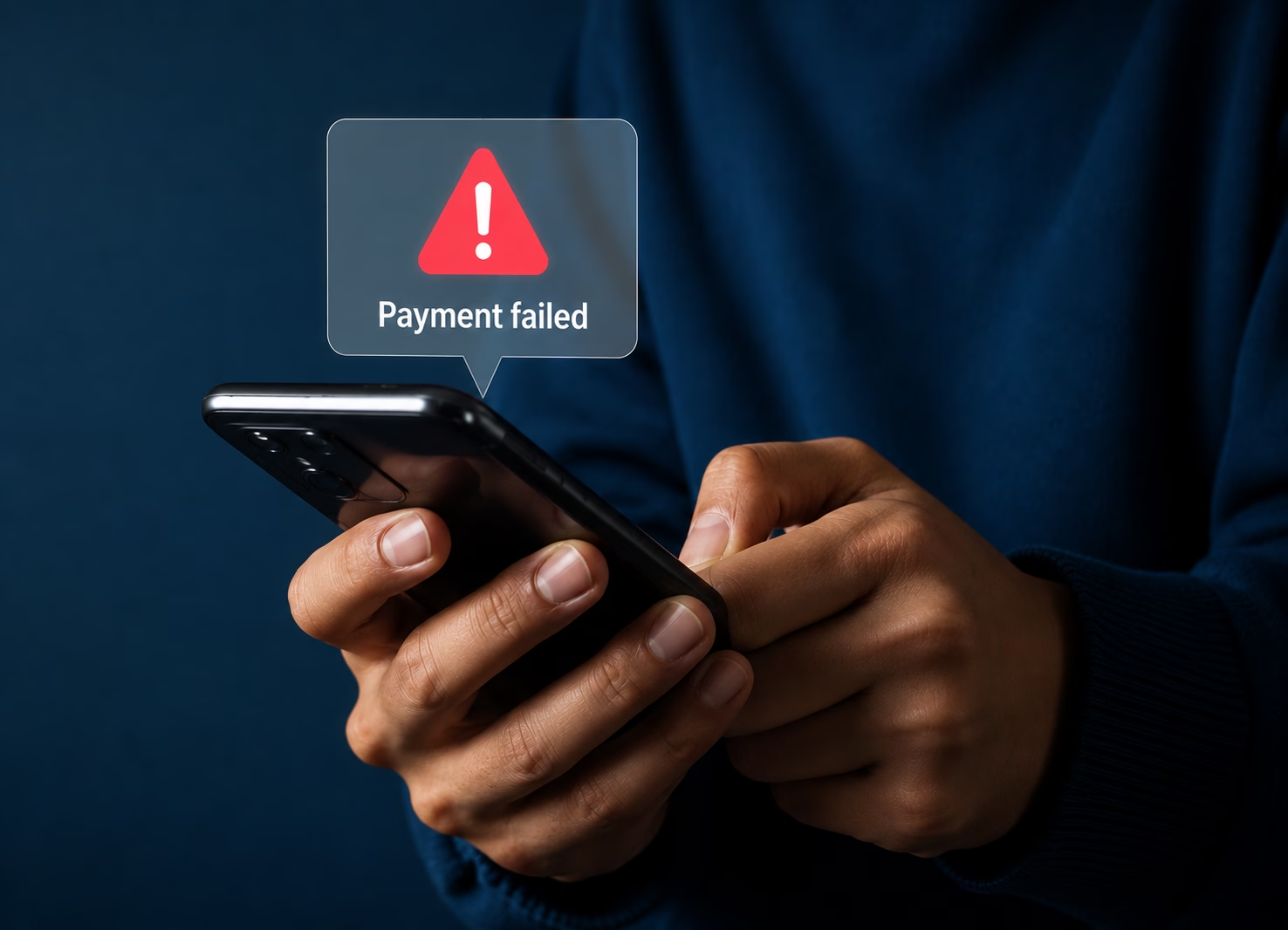
A loading screen that lasts too long. A frozen checkout button. A payment confirmation that takes several seconds.
These moments create what behavioral psychologists call “uncertainty friction.” And uncertainty creates stress because money is emotionally sensitive. Research in behavioral economics shows that people feel stronger emotional reactions to potential losses than equivalent gains. This is known as loss aversion.
So, when payment confirmation is delayed, customers immediately begin thinking:
- “Did my money get deducted?”
- “Should I try again?”
- “What if I get charged twice?”
- “Did the transaction fail?”
- “Can I trust this platform?”
The payment may still succeed technically. But psychologically, trust has already weakened. Another important behavioral concept is processing fluency. People trust experiences that feel smooth and effortless. Fast, seamless payments reduce cognitive effort. The brain interprets that ease as competence and safety.
Slow or interrupted experiences do the opposite. They force customers to pause, think, question, and reassess risk. That interruption matters because trust in digital commerce is often emotional before it becomes rational.
Customers rarely analyze payment infrastructure logically. They react instinctively to how the experience feels. Which is why payment speed has become more than a technical metric. It has become part of customer psychology.
The modern customer has been trained to expect immediacy
Consumer expectations around payments have changed dramatically over the last few years.
Real-time experiences now dominate everyday digital behavior:
- Instant messaging
- One-click checkouts
- Same-day delivery
- Live tracking
- Instant transfers
- Tap-to-pay interactions
The result is psychological conditioning. Customers increasingly interpret waiting as system weakness.
McKinsey’s payments research highlights how digital payments are becoming simpler and faster from a user perspective, even while the underlying infrastructure grows more complex. (McKinsey)
That gap matters. Because customers do not evaluate backend complexity. They evaluate experience. And experience is often judged in milliseconds.
Slow payments create invisible trust erosion
Most businesses only notice payment problems when transactions fail completely. But trust erosion often happens much earlier.
Examples:
- Payment confirmation takes too long
- Checkout freezes briefly
- OTP authentication delays
- Transaction status remains unclear
- Refund timelines feel uncertain
- Payment pages reload unexpectedly
None of these may seem catastrophic individually. But together, they create hesitation. Behavioral science calls this “ambiguity aversion.” People lose confidence when outcomes feel uncertain or delayed.
In payments, uncertainty increases perceived risk. And perceived risk changes customer behavior:
- lower checkout confidence
- higher cart abandonment
- repeated clicks and retries
- customer support escalation
- reduced repeat purchases
This is why payment speed affects more than conversion. It affects trust memory.
Trust in payments is emotional before it is rational
Customers do not fully analyze payment infrastructure. They react instinctively.
A fast and seamless payment creates:
- Relief
- Confidence
- Predictability
- Perceived safety
A delayed payment creates:
- Doubt
- Stress
- Hesitation
- Fear of losing money
This is particularly important in digital-first economies where payment interactions increasingly define brand experience.
Research on consumer trust in digital payment systems identifies user experience, transparency, reliability, and perceived security as major trust drivers. (ResearchGate). Which means payment performance is no longer isolated from customer perception. For many businesses, it is customer perception.
The UAE’s payments environment is accelerating expectations
The UAE has become one of the region’s fastest-moving digital payments ecosystems. Instant payment initiatives, wallet adoption, QR-based experiences, and contactless behavior are reshaping customer expectations quickly.
Customers are becoming accustomed to:
- Instant confirmations
- Seamless wallet experiences
- Real-time transfers
- Frictionless checkout journeys
As payment ecosystems evolve, customer tolerance for delays continues shrinking. And businesses are increasingly competing not just on product or pricing, but on operational responsiveness. In this environment, payment speed becomes part of brand trust. Not just transaction processing.
The missed insight: payment speed is a behavioral signal
Most businesses still evaluate payment speed operationally:
- Processing efficiency
- Authorization performance
- Infrastructure uptime
Those metrics matter. But customers interpret payment speed psychologically.
Fast payments communicate:
- Reliability
- Professionalism
- Competence
- Security
- Technological maturity
Slow or inconsistent experiences communicate the opposite, even if the payment eventually succeeds. That perception gap is where trust is won or lost.
What businesses should focus on now
Businesses should start looking beyond transaction completion rates alone.
Questions worth asking include:
- How long does payment confirmation actually feel to customers?
- Where does uncertainty appear during checkout?
- How often are customers retrying transactions?
- Which payment methods create the smoothest experience?
- Are delays increasing support tickets or drop-offs?
- How visible is payment status communication?
Because in modern commerce, customers do not separate payment experience from brand experience. They experience them as the same thing.
And increasingly, trust is built in the seconds between clicking “Pay” and seeing confirmation. Choose a payments solution your customers can trust, because every payment experience shapes how they trust your business.

.avif)